MR .
KOZIIKozii Token
The token of a real-estate tokenization platform: an upgradeable BEP-20 contract with a fixed supply of one billion. I wrote it, tested it and deployed it to BNB Chain.
- Role
- Smart contract developer
- Team
- Solo on the contract
- Timeline
- June to July 2025
- Stack
- Solidity
- OpenZeppelin
- Hardhat
- TypeScript
- BNB Chain
- Links
01 · The problem
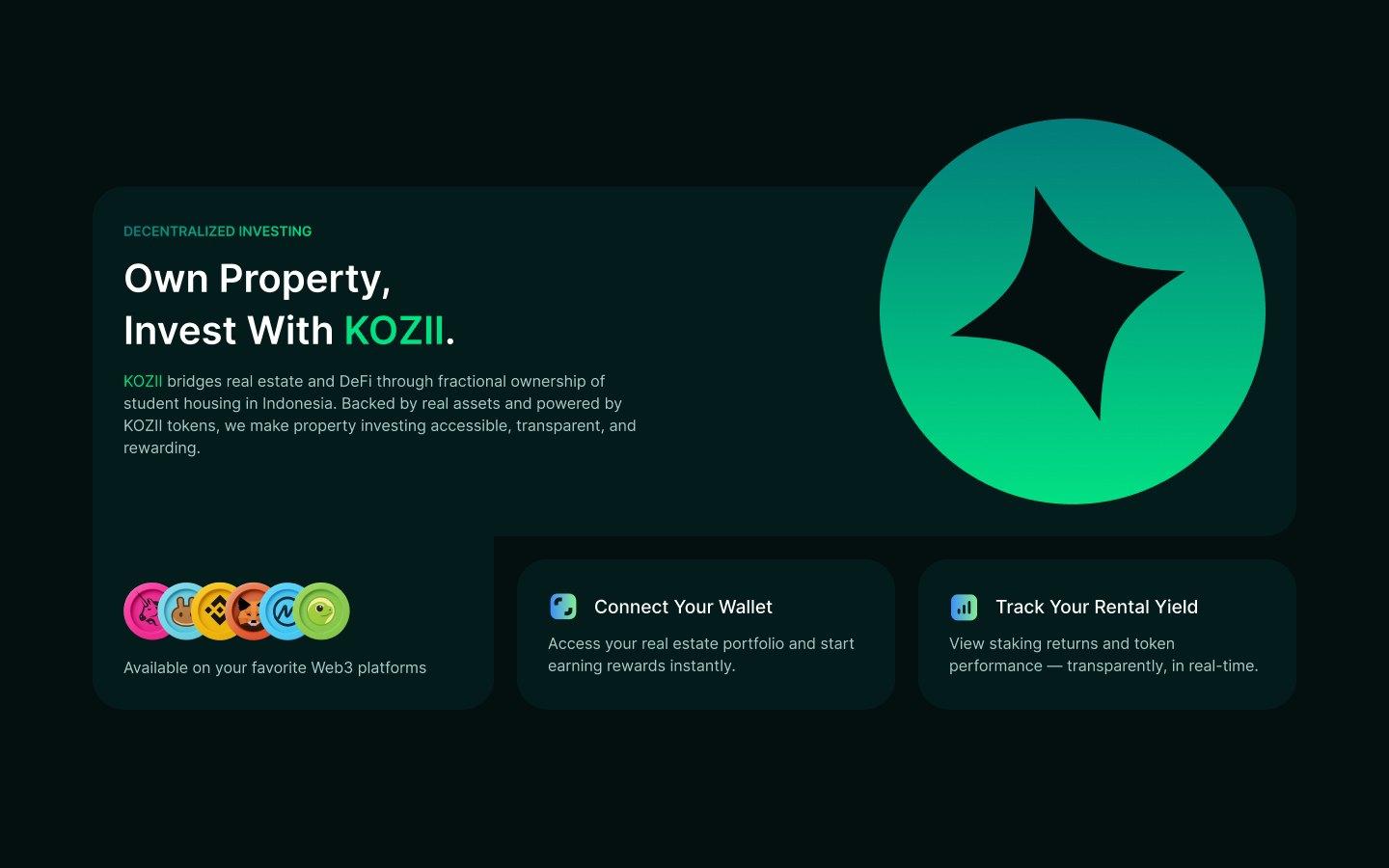
KOZII is a platform that tokenizes real estate, and it needed its own token for ownership and staking rewards, with the whole supply split between staking, the community, investors, operations and the team.
People who hold a token need to know its supply cannot change. The people who issue it need to be able to fix a bug. The first version of the contract was immutable, so it gave the first and not the second.
02 · The solution
KOZII is a fixed-supply BEP-20 token behind an upgradeable proxy. Holders and apps talk to one fixed address, the proxy. It forwards every call to the implementation that holds the logic, and only the owner can point it at a new one.
- 01
A supply that cannot grow
One billion KOZII, minted once when the token is created. There is no mint function, and creation fails unless the allocations add up to exactly the maximum.
- 02
Five allocations, set at creation
Staking rewards take 30%, community, investors and operations 20% each, and the team 10%, minted from a labelled table that rejects an empty address.
- 03
Logic that can be repaired
A UUPS proxy keeps the token's address fixed while its logic can be replaced, and the implementation behind it is locked so it can never be taken over.
- 04
Burning and one owner
Holders can burn their own tokens, and one owner holds the only privileged action, authorising an upgrade, which keeps the contract easy to reason about.
03 · Key decisions
- 01
A UUPS proxy
Instead of the immutable contract it started as.
A bug can be fixed or a feature added without changing the token's public address.
- 02
One mint, in the initialiser, with a supply check
Instead of a mint function.
The supply cannot grow, and deployment fails if the allocations do not add up to exactly one billion.
- 03
A single owner
Instead of a set of roles.
The only privileged action is authorising an upgrade, so one clear owner is easier to reason about and to audit.
04 · My role
I was the only developer on the contract. The main decision was mine: to rewrite the immutable first version behind an upgradeable proxy, keeping the supply fixed while making the logic repairable. I built guards into the deployment, so mainnet cannot run with a missing wallet, then tested the token and deployed it to BNB Chain.
What I did
- Wrote the token contract: a fixed supply of one billion, burnable by its holders, with an initialiser that mints each allocation from a labelled table and refuses to finish unless the total is exactly the maximum.
- Rewrote the immutable first version behind a UUPS proxy with a locked implementation, and added a second version and a script that rehearse an upgrade from start to finish.
- Tested deployment, allocation, burning and an upgrade that keeps its owner, with a gas report priced in BNB on every run.
- Wrote separate deployment scripts for the test network and for mainnet. Mainnet refuses to run unless every allocation wallet is set, and both print what is needed to verify the source in public.
05 · Impact
- KOZII, a fixed supply that can never grow
- 1B
- allocations, minted once
- 5
The token was deployed to BNB Chain in July 2025, with its implementation's source verified in public.
Holders can check on-chain that the supply is fixed and how it was split. The issuer can fix or extend the logic without moving the token to a new address.
Screens