MR .
AIAI Launch Kit
A guided tool that turns a new company's details into a generated website it can preview and download. I led its development, built the backend that replaced three prototypes, and restructured the web app.
- Role
- Led the development
- Team
- A small team of developers, building on interns' prototypes
- Timeline
- July to November 2026
- Stack
- React
- TypeScript
- Python
- FastAPI
- PostgreSQL
- Docker
- Links
01 · The problem
A company that has just been incorporated in the free zone has its details on file and nothing to show the world. A website, and often a brochure and a profile, takes design skill, writing and time that a new company rarely has.
A tool that writes these for the customer has to earn trust. Generated copy can invent facts about a real company, so it must stay inside what the customer actually provided. And building a site with AI is slow and depends on outside services, so a refresh or a failed step must not lose the customer's work.
The starting point was three separate prototypes that overlapped and disagreed. The work was to turn them into one product a team could test, extend and hand over.
02 · The solution
The AI Launch Kit takes what a company already has, a form, a logo, documents or an existing site, and merges it into one summary the customer can edit. From that summary it proposes a look and a set of pages, offers three designs to choose from, and builds a multi-page website to preview, download or hand off to hosting.
A React wizard talks to a FastAPI service. The service stores each project and queues the slow AI steps for a worker. The worker reaches the language model, the site builder, the image library, file storage and hosting through adapters, and progress streams back to the browser.
- 01
One summary of the company
A form, a logo, uploaded documents and an existing website are merged into one summary of the company, which the customer reads and corrects before anything is generated.
- 02
Copy grounded in the facts
Generation works from the customer's own details, with rules that keep the text to what was provided and a guardrail review of what was written.
- 03
A look the customer chooses
A mood, colours and fonts, the pages the site should have, and three generated designs to compare, so someone with no design training can still decide.
- 04
Builds that survive
Projects are stored, slow steps are queued for a worker and safe to repeat, and every status change is recorded. A long build carries on through a refresh and reports where it really is.
- 05
Preview, download and hosting
The finished site can be previewed behind the customer's sign-in, downloaded as a ZIP, or handed off to hosting, and saved projects can be reopened later.
03 · Key decisions
- 01
Business logic in a plain package
Instead of logic inside the API's route handlers.
The core never imports the web framework or reads the environment, and an architecture test enforces it. The logic can be tested and reused without a server.
- 02
Code organised by capability
Instead of broad utility and pipeline modules.
Each capability keeps its models and its logic together, so a change to image sourcing or page planning stays in one place.
- 03
Every outside provider behind an adapter
Instead of calling providers directly.
The app starts without any credentials, and every provider can be replaced by a fake, so the whole flow is tested offline.
- 04
Queued, durable operations
Instead of generating inside the web request.
A build takes minutes and can fail half-way. Stored operations and events let it resume, and let the screen show the truth.
04 · My role
I led the development of the AI Launch Kit. I scoped the work with the team, set the architecture of the backend and decided how three prototypes would become one product, then supervised the team through staging and acceptance testing.
Hands-on, I built the backend that replaced the prototypes, the storage and generation workflow behind it, and the API the wizard uses. Later I restructured the web app so the team could keep adding to it.
What I did
- Rebuilt three separate prototypes as one typed Python package, organised by capability: intake, grounding in the company's facts, design, page planning, prompts, HTML repair, profile extraction, image sourcing, storage and deployment.
- Designed the generation workflow: stored projects, queued steps a worker can safely repeat, and a recorded history of every status change.
- Built the versioned API: project drafts, profile extraction, design mockups, builds with streamed progress, a ZIP download and the hand-off to hosting, with one error shape and written documentation.
- Prepared the first hosted test environment and wired the eleven-screen wizard to the backend, from form validation to streamed progress, authenticated previews and the download.
- Restructured the web app, which lived in a single file, into one folder per page, moved the logic out of the interface and put component tests around it.
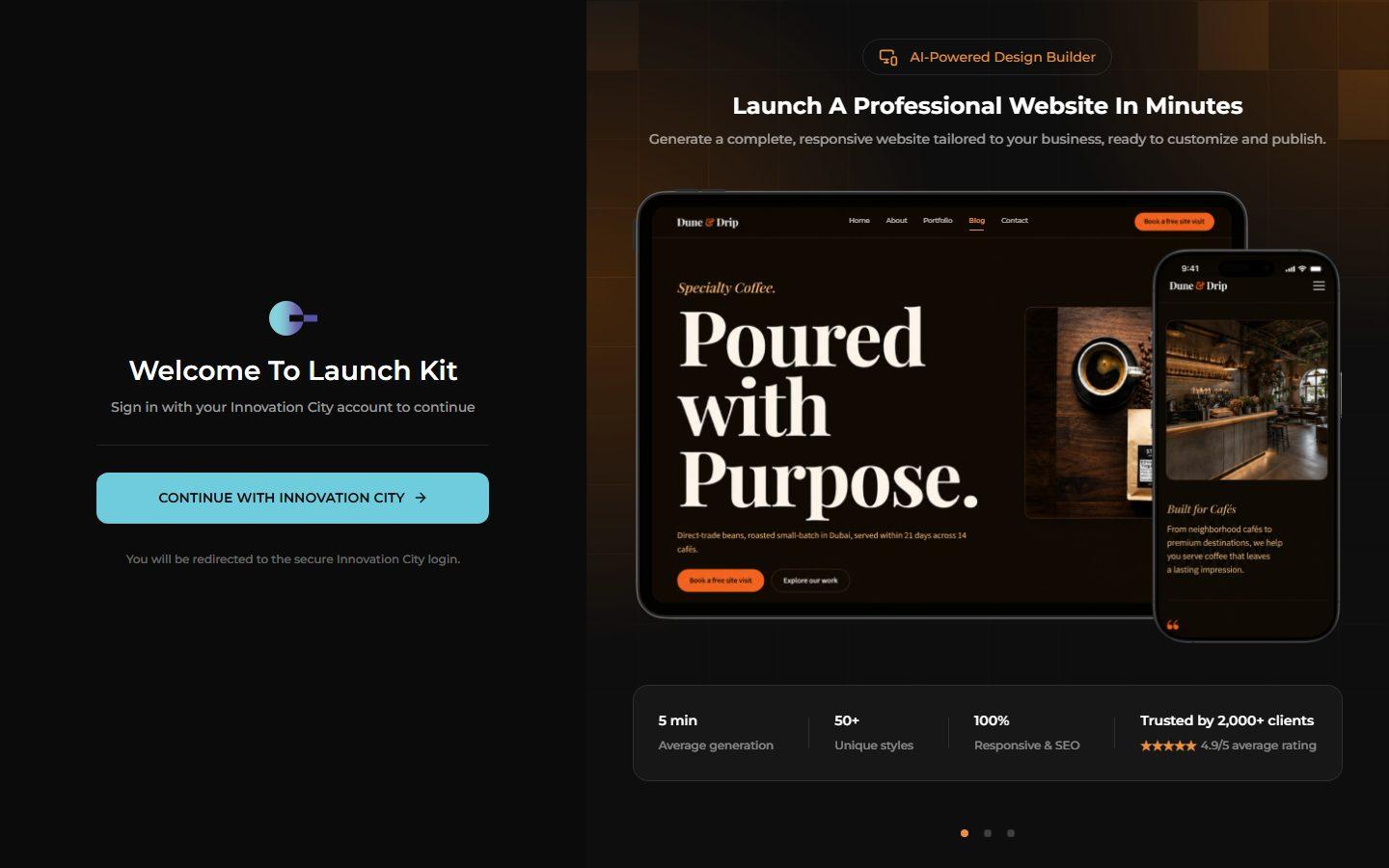
- Built the animated showcase on the sign-in page, with page-turning document mockups, a mobile layout and a still version for people who prefer reduced motion.
05 · Impact
- screens in the guided flow
- 11
- designs to choose from for every project
- 3
- documented API operations
- 20
There is one product where there were three prototypes: a flow that runs from sign-in to a downloadable website, built from the customer's own details.
The backend can be tested without a single outside service, and a change cannot merge unless test coverage stays at 90%, so the team can keep changing it with confidence.