MR .
CENTCent
A wallet and payments platform where retail and corporate customers hold, send, convert and stake funds, with an admin console for staff.
- Role
- Led full-stack delivery
- Team
- Independent client project with a small team
- Timeline
- 2025 to 2026
- Stack
- Next.js
- TypeScript
- FastAPI
- PostgreSQL
- Solidity
- AWS
- Links
- Client project, no public link
01 · The problem
A token project needed one place where customers could keep funds, move them, convert between the CENT token and USDT, and earn staking rewards. Retail customers hold and move money. Corporate customers send payments in bulk.
Staff needed control over the rules: fees, approvals and reports. And every customer's balance had to stay accurate on top of centrally managed wallet infrastructure, where deposits and payouts complete on the provider's side, not the platform's.
02 · The solution
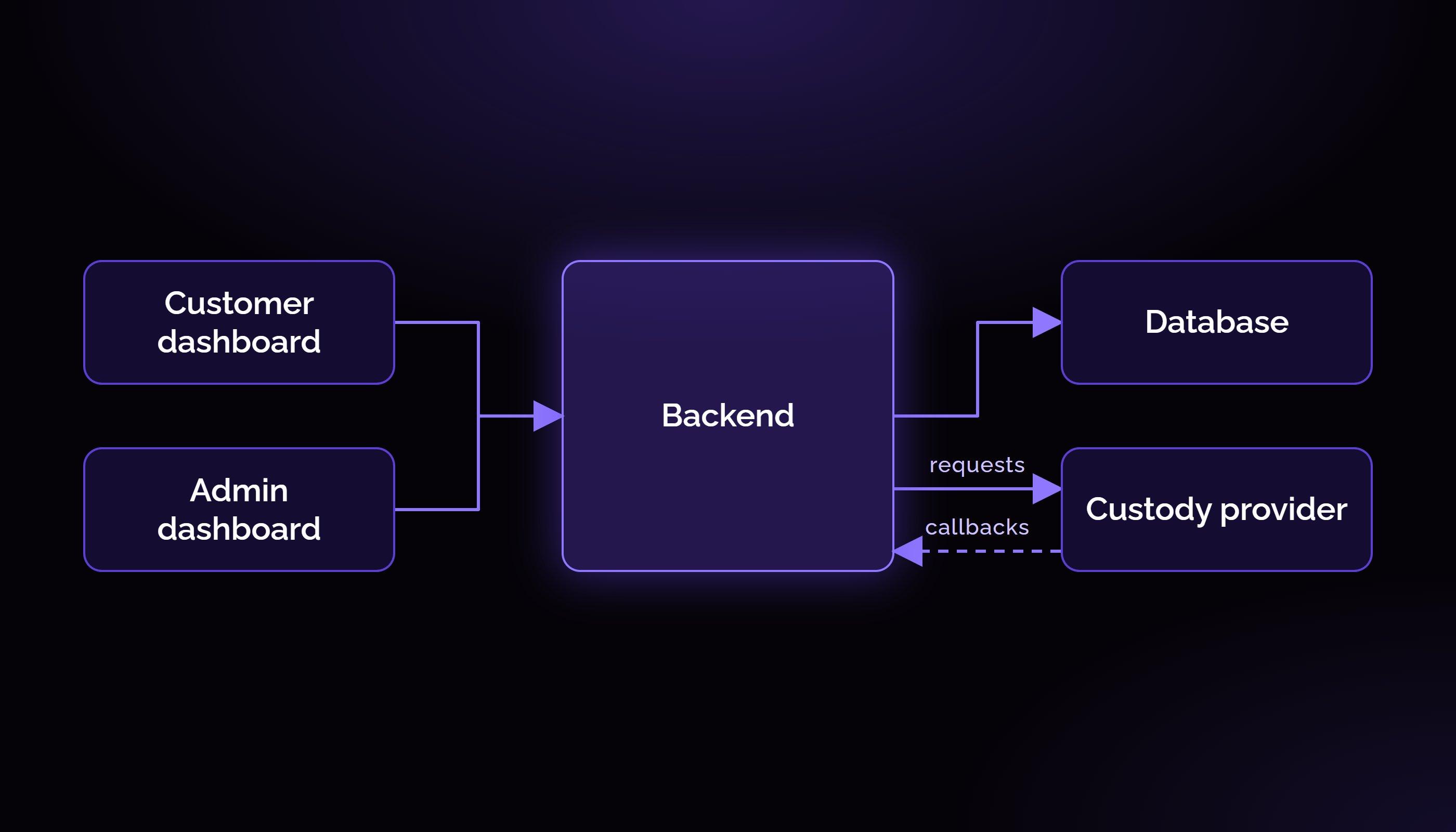
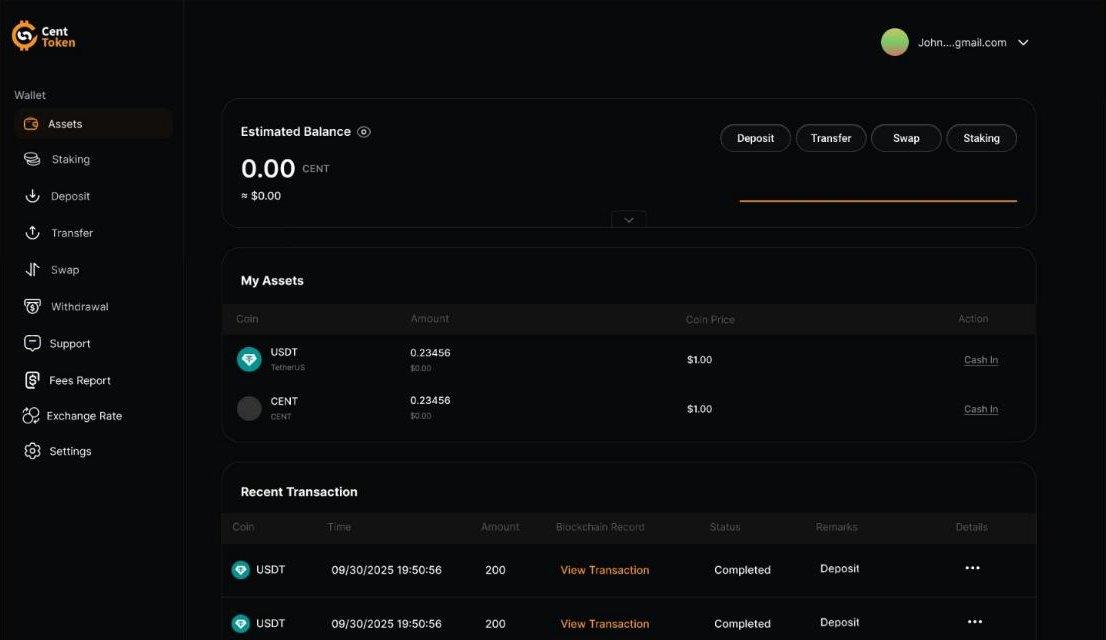
We built two web apps on one Next.js frontend, a customer dashboard and an admin console, on a FastAPI backend that keeps accounts, balances, transfers, swaps and stakes in PostgreSQL. The backend asks a custody provider for each customer's deposit address and for payouts, then listens for the provider's callbacks when money arrives or leaves.
Sign-in uses tokens and one-time codes. The CENT token itself is a separate upgradeable BEP-20 contract with a fixed supply.
- 01
Deposits and withdrawals
Each customer gets their own deposit address. A deposit is recorded when the provider's callback arrives, and withdrawals wait for staff to approve or reject them.
- 02
Transfers, single and in bulk
Customers send funds to each other as fast ledger updates, and corporate accounts send payments to many recipients in one go.
- 03
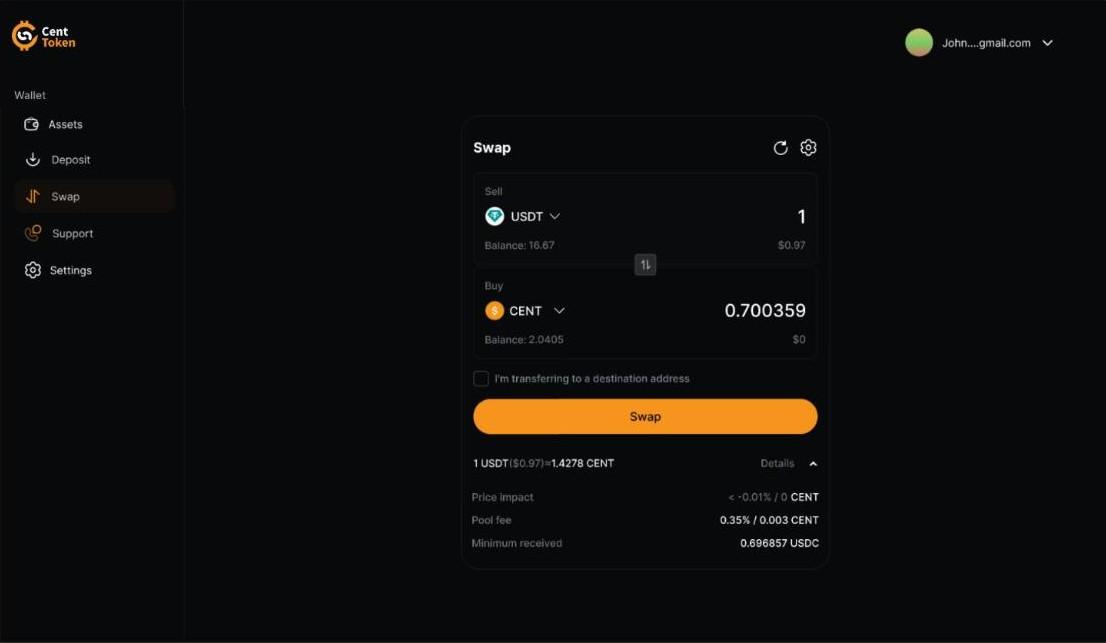
CENT and USDT conversion
Customers convert between CENT and USDT, and USDT shows as one balance per customer across networks instead of one per network.
- 04
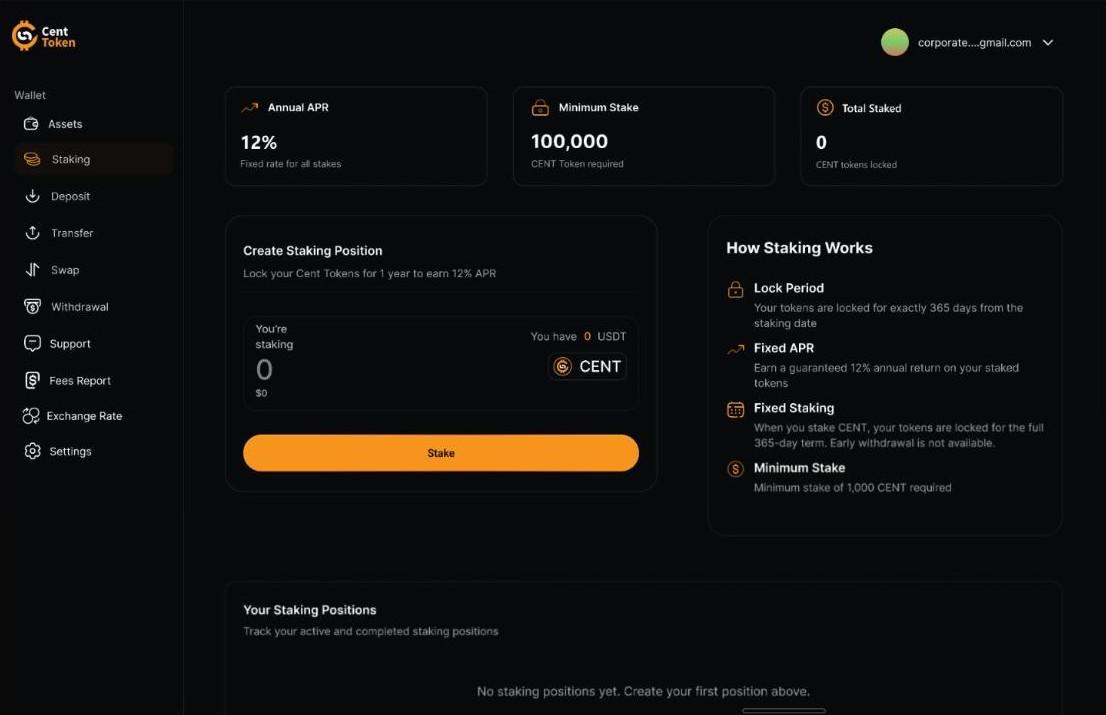
Staking and rewards
Customers stake funds in the active pool and later claim their rewards, while staff set up and manage the pools.
- 05
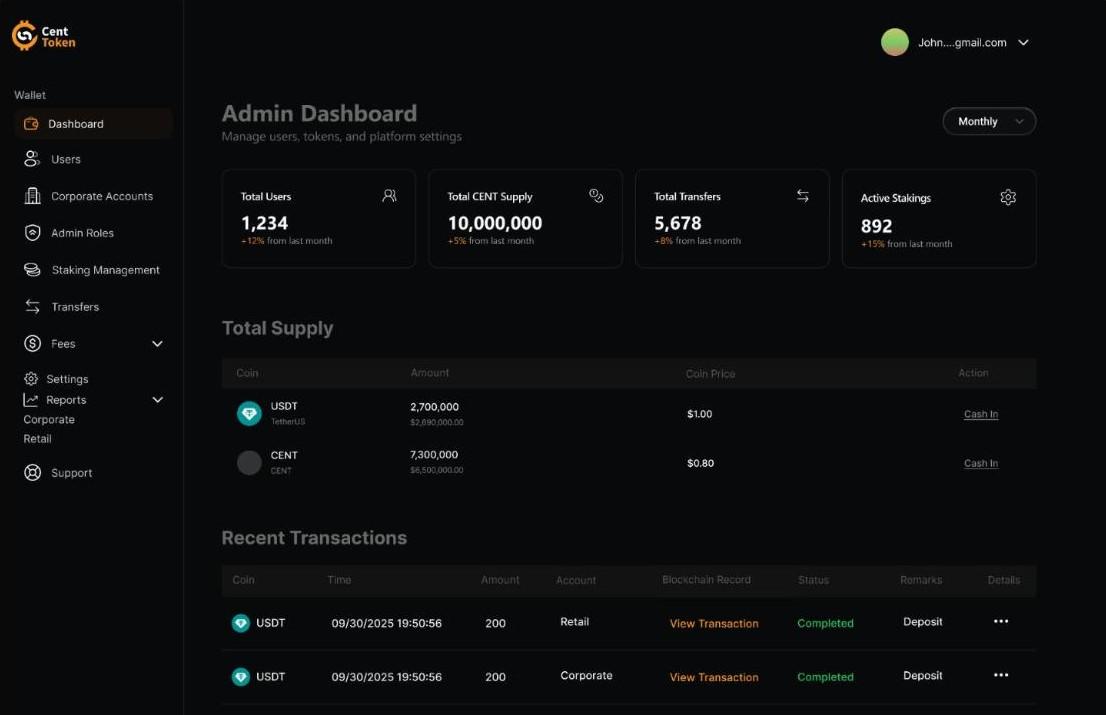
An admin console with permissions
Staff set fees, exchange rates and minimums, approve requests, answer support tickets and export reports, and each sub-admin gets only the permissions they need.
03 · Key decisions
- 01
The backend keeps its own ledger
Instead of moving funds on-chain for every action.
Most transfers are fast database updates, and funds move on-chain only when needed. The cost is keeping the ledger and the chain in agreement.
- 02
One USDT balance per customer
Instead of a separate balance on each network.
People do not manage balances per network. The backend decides which underlying wallet to draw from.
- 03
Fee rules stored as data
Instead of fees written into the code.
Staff change fees by account type and threshold from the admin console, without a release.
- 04
An upgradeable token contract
Instead of a fixed contract.
Bugs can be fixed without changing the token's public address.
04 · My role
I led delivery of Cent from requirements and planning through implementation to handover, and wrote almost all of the backend: accounts, wallets, deposits, withdrawals, transfers, conversion, staking, fees, permissions and reports.
The hardest part was moving money safely between the ledger and the custody provider. I wrapped the provider behind one client with separate deposit, payout and withdrawal services driven by its callbacks, checked addresses and network-fee balances before every payout, and reworked balances, swaps and fees so USDT behaves as one balance. On the frontend I worked on the admin console, the customer dashboard and the API layer alongside the other developers.
What I did
- Led delivery from requirements and planning through implementation and handover.
- Built the FastAPI and PostgreSQL backend: accounts, wallets, deposits, withdrawals, transfers, conversion, staking, fees, permissions and reports.
- Integrated the custody provider: a deposit address per customer, deposit callbacks, payouts and withdrawals.
- Designed the ledger and the single USDT balance across networks, with fees collected on swaps in both directions.
- Worked on the admin console, the customer dashboard and the frontend's API layer with the other developers.
- Wrote and deployed the upgradeable BEP-20 token contract.
05 · Impact
Retail customers, corporate customers and staff each have their own dashboard on one platform, covering deposits, withdrawals, transfers, conversion, staking, fees, permissions and reporting.
Staff change fees, rates and permissions from the admin console instead of waiting for a release. The platform was built and handed over to the client.
Screens