MR .
INNOVATIONInnovation City Website
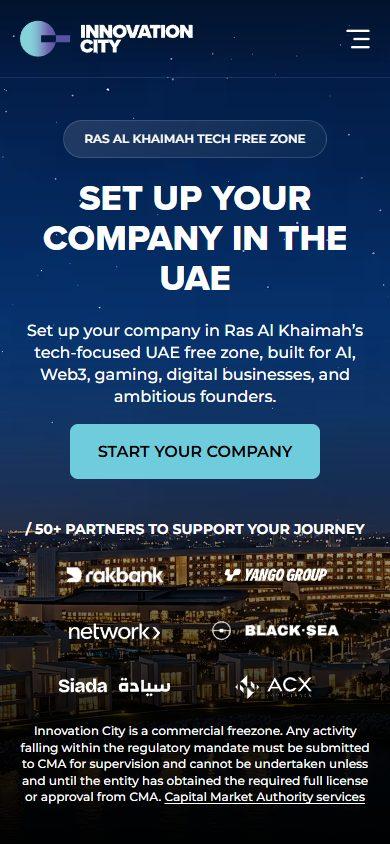
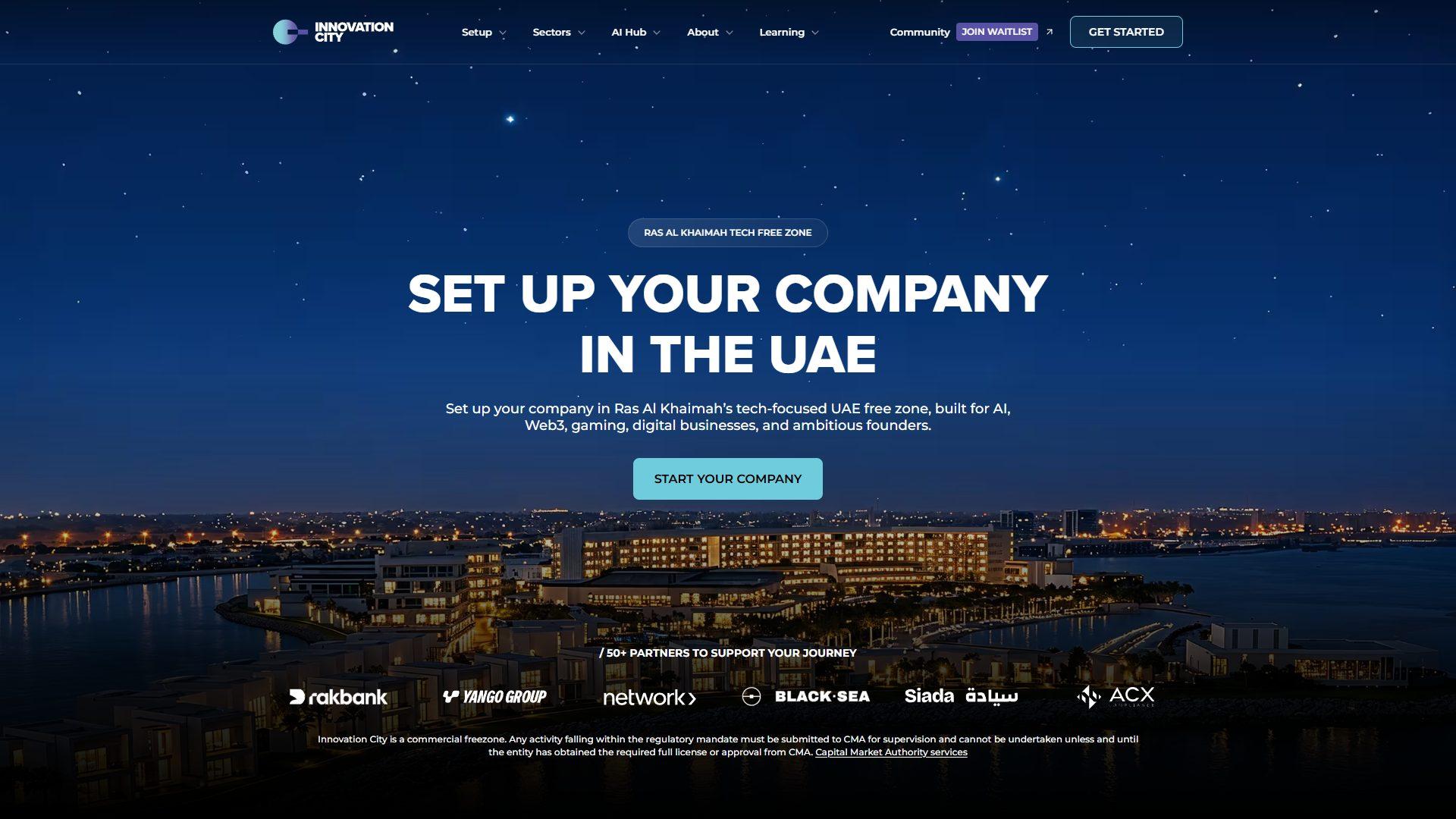
The public website of a UAE technology free zone, rebuilt as a fast, scalable platform: a shared design system, a page builder in the CMS, and the monitoring to keep it fast.
- Role
- Lead, website development and roadmap
- Team
- A small development team, with Marketing and Commercial
- Timeline
- 2025 to 2026
- Stack
- Next.js
- TypeScript
- Tailwind CSS
- Sanity CMS
- Salesforce
- Sentry
- Links
01 · The problem
The website is where founders decide whether to set up in Innovation City, and where Marketing and Commercial meet them: campaigns, sector and partner pages, pricing, enquiries. As the free zone's digital work grew, the site had to keep up with it, and it could not.
Every new page was built largely from scratch, so launching a campaign or a new offering took developer time it should not have needed. Pages did not share one look or one set of parts, which made the site harder to keep consistent and to maintain. Mobile pages were slow, and new ideas, from AI tools to new kinds of digital product, had no clean place to plug in.
The goal was a web platform that is fast for visitors, quick for the team to build on, and open to whatever the free zone launches next. Moving from the old WordPress site to Next.js was the means, not the goal.
02 · The solution
We rebuilt the site on Next.js and TypeScript with Sanity as its CMS. One design system feeds both the components and the pages. Editors assemble pages from predefined sections in the CMS and publish without a release, and the site is measured and monitored so it stays fast as it grows.
- 01
A design system the team builds with
Colours, type and themes defined once as design tokens, including light, dark and per-section dark modes, behind a shared library of components that every page is made from.
- 02
Pages assembled in the CMS
Editors compose a page from predefined sections, such as heroes, listings, rich text, contact and navigation, and publish it without waiting for a developer or a release.
- 03
Fast, findable pages
Pages tuned against a site-wide audit, with a sitemap that drops redirected URLs, canonical tags, structured data for the organisation, services, articles and FAQs, and an llms.txt for AI search.
- 04
Tools and integrations that plug in
A cost calculator, a company-name check with reservation, the Sky assistant, and enquiries that reach Salesforce with their source attached. New features arrive as a section or a route, not a rebuild.
- 05
Monitoring built in
Sentry across the browser, the server and the edge, with session replay on errors and filters that keep noise out, so problems are seen and traced before visitors report them.
03 · Key decisions
- 01
Pages assembled from sections in the CMS
Instead of a developer building each page.
A new page or campaign is put together from parts that already work and already look right, and published without a release.
- 02
One set of design tokens behind every component
Instead of styles set page by page.
Colours, type and themes change in one place, and every page stays consistent with the others.
- 03
Measure every page before fixing any
Instead of fixing whatever looked slow.
A site-wide audit ranked the problems, so the fixes that cost visitors the most went first.
- 04
Heavy third-party scripts loaded later
Instead of everything on first load.
Monitoring, chat and marketing scripts were what slowed phones most. They now load after the page is usable, or on first interaction.
- 05
Every enquiry stored before it is sent on
Instead of relying on the CRM to accept it.
A lead is never lost because Salesforce is slow or rejects it, and each one keeps its source for marketing.
04 · My role
I lead the website's development and plan its roadmap with Marketing and Commercial. I turn what they need into work for the team, review and merge what the team builds, and set how we work: from a ticket to a branch, a review, staging and production.
Beyond leading it, I own the parts that make the platform fast, measurable and connected.
What I did
- Ran the site-wide performance audit across every page, wrote its action plan and made many of its fixes, and wrote the playbook so the audit can be run again.
- Set up monitoring with Sentry across browser, server and edge, including error-only session replay and the filters that keep noise out.
- Built the service that carries enquiries to Salesforce: it stores every attempt first, keeps each lead's source and routes it as a lead or a case.
- Built the cost calculator and the company-name check with its reservation flow, and integrated the Sky assistant into the site.
- Led technical SEO and GEO: the redirects, the Search Console audit, structured data and the llms.txt for AI search.
- Build reusable components and CMS integrations, and maintain analytics with Google Tag Manager and Search Console.
05 · Impact
- average mobile Lighthouse Performance score across 125 pages
- 78 → 95
- pages scoring 90 or more on mobile, of 125
- 1 → 112
- shared components in the design system
- 181
- section types editors build pages from in the CMS
- 13
Mobile pages got markedly faster: median Total Blocking Time fell from 226 ms to 72 ms and median Largest Contentful Paint from 4.1 s to 2.2 s, with no layout shift. These figures come from comparable pre-release audits of the same 125 pages, not from production. In production the site scores 98 for accessibility and 99 for SEO.
The team now builds pages from parts that already exist, editors publish without a release, and new tools plug in as a section or a route. When something breaks, Sentry shows it before a visitor has to report it.
Screens