MR .
SKYSky on Telegram
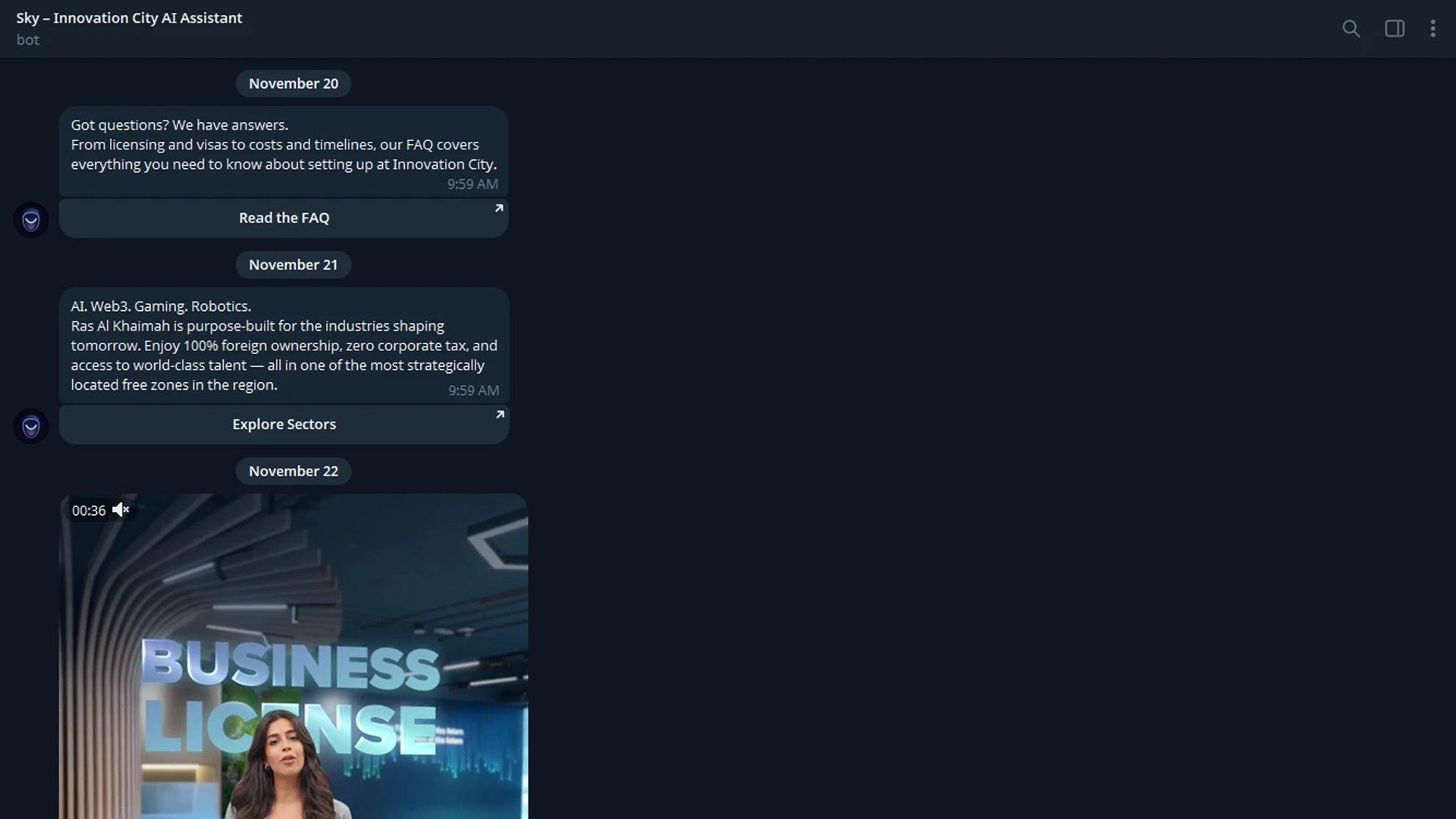
The Telegram channel for Sky, Innovation City's customer-support assistant. I wrote the first bot, then hardened it for production and gave operators a control panel.
- Role
- Led the development
- Team
- Two developers
- Timeline
- April to July 2026
- Stack
- Node.js
- TypeScript
- Redis
- Telegram Bot API
- Docker
- Links
01 · The problem
Sky already answered customers on Innovation City's website. Many of the same people spend their day on Telegram, in private chats and in groups, and the support had to reach them there with the same answers.
A group is public. An assistant that replies to everything, or repeats someone's details in front of others, loses people's trust at once.
The bot also handles enquiries from real prospects and sends scheduled messages. If it forgets its state it can reset a conversation or message many chats twice, and the people running it need to change who it talks to without waiting for a developer.
02 · The solution
We built a thin channel in front of the same assistant. Telegram sends each update to a small service that acknowledges it at once and processes it in the background. The service maps each user to a conversation with the assistant, which holds the memory. The bot itself keeps only mappings, preferences and schedules, in Redis.
- 01
Private chats and groups
In a private chat it answers like the website does. In a group it speaks only when it is mentioned, replied to or asked with a command, then offers to carry the conversation into a private chat with its context intact.
- 02
The same assistant on both channels
Each Telegram user is mapped to a conversation with the assistant, so the answers and the memory are the same as on the website.
- 03
Safe in public
Rate limits, safe message formatting, protection against duplicate updates, recovery from expired sessions and timeouts on every outside call keep it well behaved in busy groups.
- 04
Scheduled reminders
Rotating messages with cooldowns and quiet hours, with images and video and a text fallback. One recipient failing never stops the rest of the batch.
- 05
A control panel for operators
An authenticated dashboard to allow or block groups and users, choose which announcements go to which audience, and edit reminders, all without a redeploy.
03 · Key decisions
- 01
A thin channel adapter
Instead of a second assistant with its own memory.
The assistant holds the conversation history. The bot only translates between Telegram and it, so both channels give the same answers.
- 02
Redis as the durable state
Instead of process memory, or a SQL database added just in case.
Losing state can reset a prospect's conversation or repeat a scheduled message, and the data is small and key-shaped.
- 03
Routes, handlers and services in one modular service
Instead of splitting into microservices.
The size favours one deployable unit. Each outside provider still has its own service with typed requests and responses.
- 04
Policy kept in an admin store
Instead of redeploying to change who the bot talks to.
Defaults plus overrides, with blocklists winning, can be changed by an operator in the middle of an incident.
04 · My role
I led the bot's development in a team of two. I wrote the first version and set its shape: a thin channel in front of the assistant, with its state in Redis. Before go-live I audited the whole service and worked through what the audit found.
Then I gave the people who run Sky control over it, so changing who the bot talks to or what it announces no longer needs a developer or a redeploy.
What I did
- Wrote the first bot: the webhook service, routing for private and group chats, a session for each user mapped to the assistant, commands, rate limits, safe formatting, protection against duplicate updates, and the links that move a group question into a private chat.
- Built the scheduled reminders, with cooldowns, quiet hours, images and video with a text fallback, controls over their order, and one fixed timezone for the schedule.
- Audited the service before go-live, then fixed what it called for: security and privacy, recovery from expired sessions, timeouts on outside calls, graceful shutdown, linting and continuous integration.
- Built the authenticated admin API and dashboard that let operators allow or block groups and users, target announcements and edit reminders.
- Made the rotation reliable: the reminder list and its position are claimed in one atomic step, and one recipient failing no longer stops the rest of the batch.
- Packaged it as a multi-stage, non-root container with a health check and Redis alongside it, and wrote the runbooks for going live.
With the team
With the team, the bot also gained voice messages, Arabic, and announcements written from the website's content.
05 · Impact
- operations in the admin control panel
- 27
- chat commands
- 10
- languages, English and Arabic
- 2
Customers reach the same assistant on Telegram as on the website, and the people who run it can change its behaviour without a developer.
In groups it answers only when asked and moves personal questions into a private chat, and scheduled messages keep their place and go out once, because the bot no longer depends on what one process remembers.